FUE vs DHI: Which Hair Transplant Technique Is Right for You?
Both methods harvest and transplant your own hair — the difference lies in how the grafts are placed. Here is how to decide which approach fits your hairline goals.
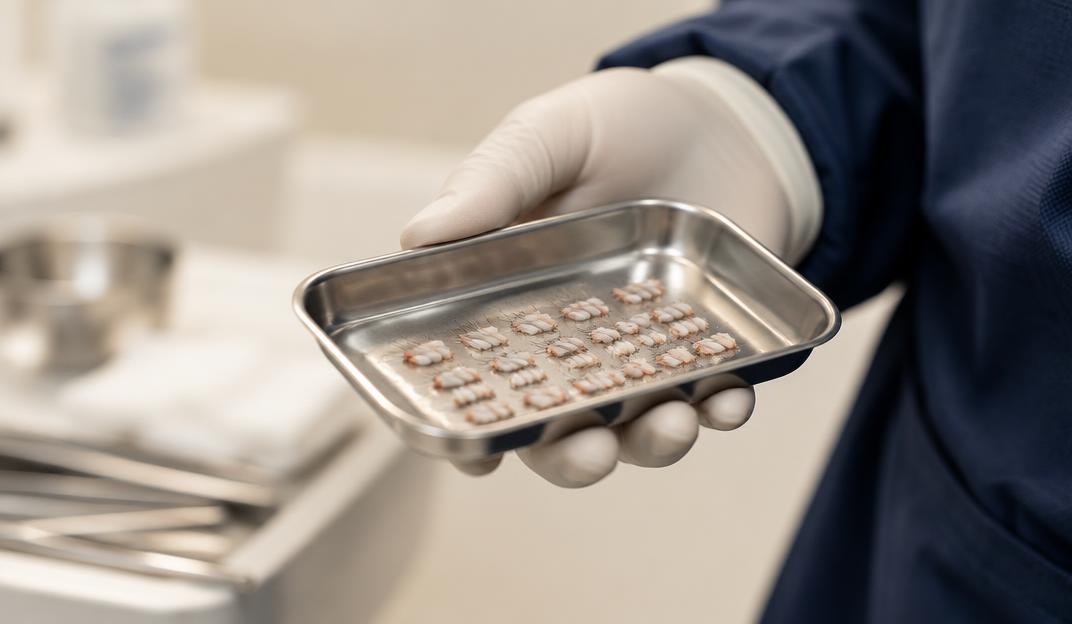
If you have spent any time researching hair restoration, you have almost certainly come across two acronyms again and again: FUE and DHI. Clinics market them as rivals, but the honest answer is more interesting — they are two points on the same spectrum, sharing the same core principle. Both take healthy follicles from the back and sides of your head (the donor area) and relocate them where hair has thinned.
The real difference is in the placement step, and understanding it will help you have a much more productive consultation.
How FUE works
In Follicular Unit Extraction, the surgeon creates tiny incisions — called recipient sites — in the thinning area first, then places the harvested grafts into those pre-made channels. Because the angle, depth and direction of every site are planned before any hair is placed, the surgeon has full control over the final hairline design.
FUE is the workhorse of modern hair restoration. It suits large coverage areas, such as a receding hairline combined with thinning across the mid-scalp, because the sites can be laid out systematically across a wide surface.
How DHI works
Direct Hair Implantation uses a specialised pen-like instrument (often called a Choi pen) that makes the incision and places the graft in a single motion. No pre-made channels are needed.
That one-motion approach has practical advantages in specific situations: working between existing hairs without shaving a wide area, rebuilding a fine hairline with tight control over angle, and treating smaller zones where precision matters more than volume.
Which one should you choose?
The right question is not "which technique is better" but "which technique fits my pattern of hair loss and my donor supply". As a rough guide:
- Extensive thinning across several areas usually favours FUE — speed and coverage matter.
- A focal hairline rebuild, especially with existing hair to protect, often favours DHI.
- Many experienced surgeons blend both: FUE across the broader thinning zones and DHI along the frontal hairline where every angle is visible.
- Your donor area quality is decisive in both. No technique can compensate for an insufficient donor supply.
What matters more than the acronym
Results correlate far more strongly with the surgical team's planning and handling of the grafts than with the brand name of the method. Grafts are delicate tissue: time spent outside the body, hydration, and the angle at which they are placed all influence how much of the transplanted hair survives and how natural it looks.
During a consultation, ask how the hairline will be designed, how many grafts your donor area can safely support, and what the day of surgery looks like. A clinic confident in its process will answer all three without hesitation.
Talk to us about your hair
Every head is different. Book a free consultation and get an honest assessment of your donor area, your options and a realistic plan — with no obligation.