Transplanting Afro and Textured Hair: What Is Different
Curly and coily hair is one of the best indications for a transplant — but the follicles behave differently under the blade, and the hairline has to be designed differently too.
Textured hair is a genuinely favourable candidate for transplantation. Each follicle carries more than one hair, the curl gives the illusion of greater volume, and the donor zone at the back and sides is typically dense and resilient. Which is exactly why it deserves a technique discussion of its own rather than the same script written for straight hair.
Almost everything that makes Afro hair attractive for a transplant also makes it more demanding to harvest.
The follicle is curved — and that changes everything
In straight hair, the follicle runs roughly perpendicular to the scalp, so a punch around it follows a predictable path. In tightly curled hair, the follicle bends as it descends, sometimes sharply. A punch driven straight down at a follicle that curves sideways will cut it.
That cut rate — transection — is the number that quietly determines your result. A transected graft cannot grow, so a high transection rate means you have spent donor follicles for nothing. In textured hair, the difference between a careful surgeon and a rushed one is not visible on the day of surgery; it becomes visible nine months later, in how much of the planned density actually arrived.
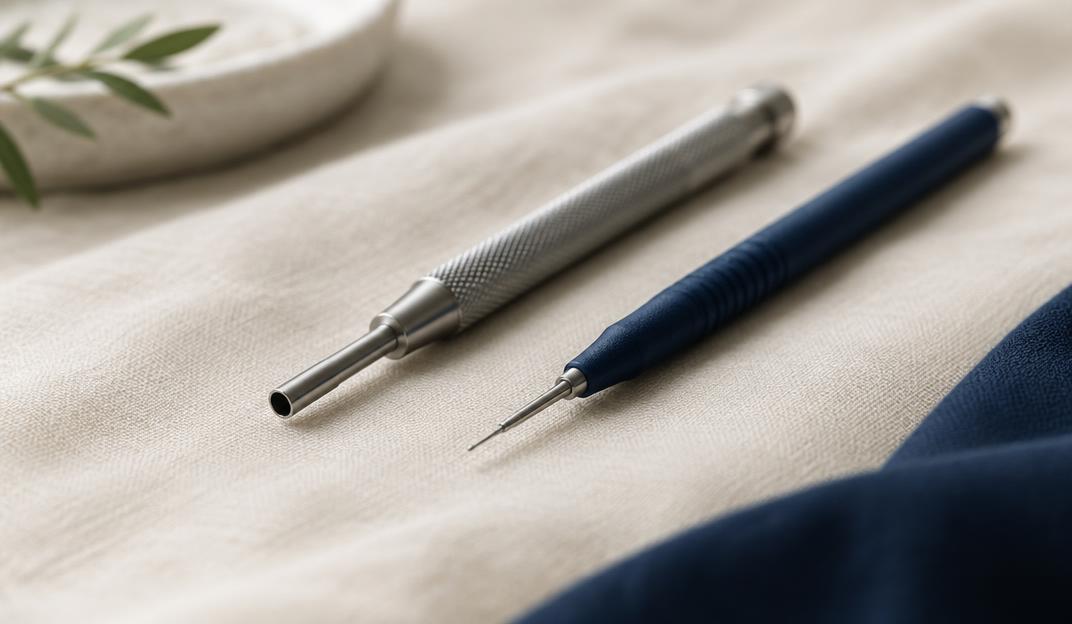
What keeps the rate low is technique: mapping the direction of the curl before cutting, angling the punch to follow the follicle rather than fighting it, extracting with controlled torque, and never rushing a session to hit a graft target.
Why fewer grafts can look fuller
Curly hair shrinks as it grows: a strand that measures 5 cm stretched may sit at 3 cm on the head. That shrinkage, plus the way each coil stands away from the scalp, means textured hair covers more surface per graft than straight hair does.
The practical effect is that a plan which would look thin on a patient with fine straight hair can look full on a patient with coils — and that a graft count quoted from a photograph is meaningless without knowing the curl pattern.
Designing a hairline that belongs on the face
This is where textured hair is most often ruined. A straight, evenly-spaced, ruler-flat hairline looks artificial on anyone, but on Afro hair it looks actively wrong — because a natural Afro hairline is not a line at all. It is irregular, with single follicles scattered slightly forward and a gentle fade in density toward the temples.
- Single-hair grafts at the very front edge, two- and three-hair units behind them.
- A slightly irregular, soft front rather than a sharp geometric boundary.
- Temples rebuilt with a taper, not filled solidly to a hard corner.
- A hairline height that suits the face and can be worn short, since many patients with textured hair keep their hair closely cropped.
Aftercare that respects the curl
The first weeks demand the usual caution — no rubbing the grafts, no picking scabs, gentle washing with the supplied lotion and shampoo. But textured hair carries extra considerations that straight-hair aftercare sheets often omit.
Tight styles are the main one. Braids, dreadlocks and cornrows pulled close to the scalp put traction on both the new grafts and the donor area, and should wait until the surgeon confirms the grafts are fully settled. Chemical relaxers and texturisers should stay well away from the treated zones during healing. And because coily hair is naturally drier, the moisturising routine that normally keeps it comfortable has to be adjusted around the healing scalp rather than abandoned.
At Bonita Hair Clinic in Cape Town, textured hair is treated as a specialism in its own right — from curl-aware extraction through to hairline design and a follow-up routine that fits how you actually wear your hair. The all-inclusive R35,000 package covers the procedure, medication, the aftercare kit, a post-operative PRP session and yearly follow-up, with no hidden extras.
Talk to us about your hair
Every head is different. Book a free consultation and get an honest assessment of your donor area, your options and a realistic plan — with no obligation.