Your Donor Area: How Much Hair You Can Safely Give
Every transplant is funded by a finite bank of follicles at the back and sides of your scalp. Here is how surgeons work out your limit — and how to spot the warning signs of going past it.
A hair transplant does not create hair. It moves hair that is already resistant to loss from one part of your scalp to another. That means every graft in your new hairline came out of a supply that cannot be replenished — your donor area.
Treating that supply as a budget, rather than as an endless resource, is the single most important idea in hair restoration planning.
Where the limit comes from
Donor capacity is not one number, it is the product of four measurements, and a good consultation reports all of them:
- Density: how many follicular units sit in each square centimetre of the donor zone, usually counted with a dermatoscope rather than estimated by eye.
- Follicles per graft: some units carry one hair, some carry three or four. Two patients with identical graft counts can have very different hair totals.
- Scalp laxity: how much the skin stretches. A looser scalp tolerates more extraction; a tight one does not.
- Hair calibre: the thickness of each strand. Coarse hair covers more scalp per graft than fine hair, which changes how much you actually need.
Put together, most men have somewhere in the region of 5,000–7,000 harvestable grafts available across a lifetime. Some have considerably less. That is the entire account from which every session — today's and any future one — is drawn.
The safe zone is smaller than people assume
Not every hair at the back of your head is fair game. Follicles high on the crown or low on the nape can carry the same sensitivity to loss as the hair that has already thinned, and harvesting them weakens the very area you are relying on. Surgeons call the dependable band the safe donor area, and its boundaries are individual: it can be narrower on the sides in some patients, shallower at the nape in others.
A plan that quietly reaches outside that band to hit a headline graft number is borrowing from an account that will not pay it back.
What over-harvesting looks like
The warning signs are visible, and they are permanent. A donor area that looks moth-eaten or translucent from behind. White dots where follicles were removed and did not regenerate. A halo of noticeably thinner hair around the sides. A patient who can no longer wear his hair short without the back looking sparse.
The uncomfortable part is that over-harvesting can be done in a single session that looks successful from the front. A full hairline with a damaged donor area is not a good result — it is a result with a bill attached.
How a responsible plan protects it
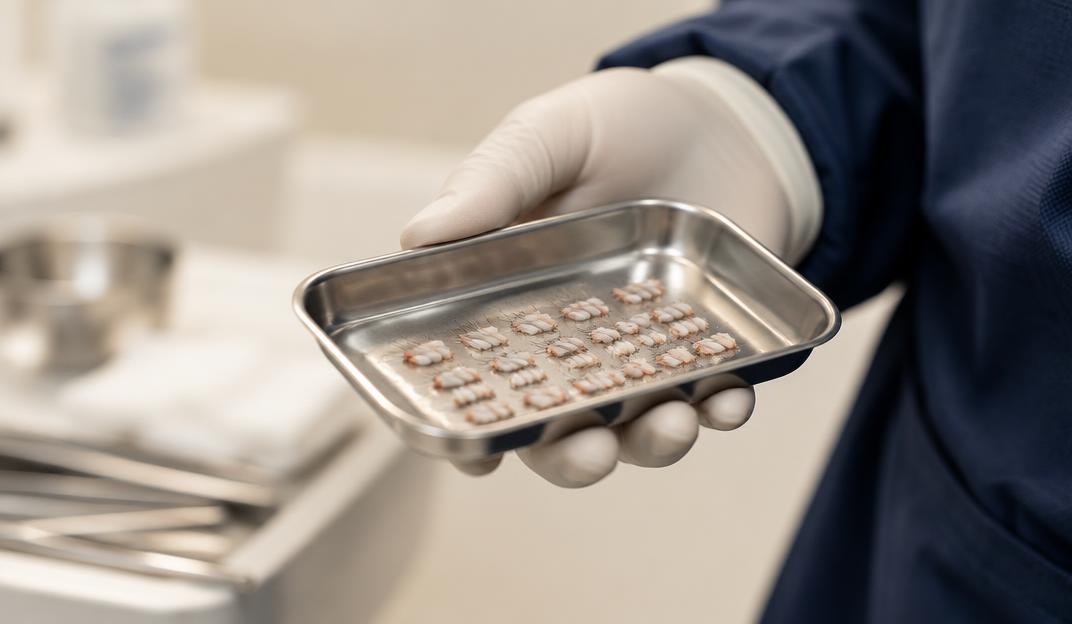
In practice, protection is a set of decisions made before the first graft is extracted: a clear ceiling on how many follicles are taken in one session, follicle-sparing extraction that keeps the surrounding units intact, and a distribution of harvest across the whole donor band instead of concentrating it in one convenient patch.
It also means declining a request. If a patient wants maximum density in the crown today and that leaves nothing for the hairline in ten years, the correct answer is to say so and propose a staged plan instead.
At Bonita Hair Clinic in Cape Town, the donor area is measured and photographed before any number is quoted. The all-inclusive package at R35,000 covers a session of up to 4,500 grafts, medication, the aftercare kit, a post-operative PRP session and yearly follow-up — and the yearly follow-up is where the donor area gets re-checked, because the budget has to last a lifetime, not one procedure.
Talk to us about your hair
Every head is different. Book a free consultation and get an honest assessment of your donor area, your options and a realistic plan — with no obligation.