Hair Loss After Pregnancy: Why It Happens and When It Settles
Heavy shedding three months after birth is one of the most common — and most alarming — things a new mother experiences. Almost always it is temporary, and here is the timeline that explains why.
The pattern is remarkably consistent. Pregnancy comes with thick, glossy hair — the kind that gets complimented. Then, somewhere around the third or fourth month after the birth, the hair starts coming out in handfuls: in the shower, on the pillow, on the brush, in a way that is genuinely frightening when you are already exhausted.
The reassuring part is that this is one of the best-understood forms of hair loss there is — and one of the most reversible.
Why pregnancy holds hair in place
Hair cycles through growth and rest phases. During pregnancy, elevated oestrogen keeps an unusually large share of follicles parked in the growth phase instead of moving on to rest. That is why hair looks fuller for nine months: the hair that would normally have been shed each month has been deferred.
After the birth, hormone levels fall quickly and the deferred shed arrives all at once. Every follicle that skipped its exit during pregnancy takes its rest phase together — so the shedding that should have been spread across nine months lands in a few weeks. Clinically this is telogen effluvium, and it typically peaks around three to four months postpartum.
What is normal, and for how long
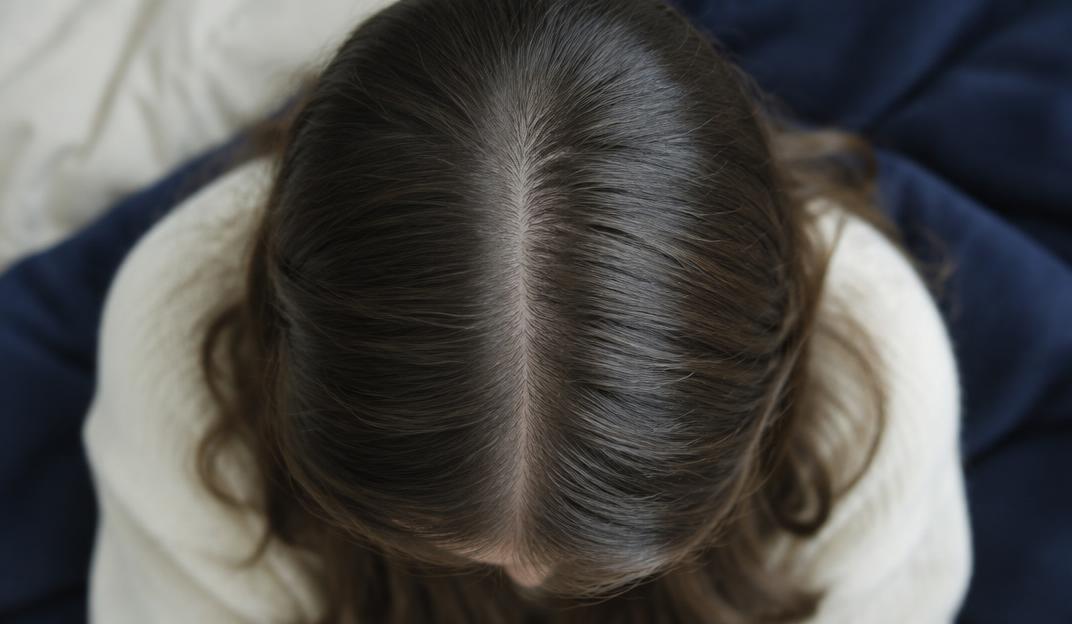
Normal postpartum shedding is diffuse — all over the scalp, worse at the crown and hairline where you notice it most — rather than in distinct bald patches. It gradually eases and, for most women, regrowth is well under way by six months and largely complete by nine to twelve.
- Expected: widespread shedding that slowly lessens, with short new strands appearing along the parting and hairline.
- Worth investigating: shedding that is still heavy beyond six to nine months.
- Worth investigating: clearly circular or patchy bald areas, or visible thinning confined to one region.
- Worth investigating: a widening parting that keeps widening once the shedding has stopped.
The checks that are worth doing
Breastfeeding, sleep deprivation and depleted stores all pile onto a shed that is already hormonally driven — so it is sensible to rule out the things that make it worse. A GP can check ferritin and iron status, thyroid function and vitamin D, all of which are commonly low after pregnancy and all of which can prolong shedding if they stay low.
That conversation belongs with a doctor who can look at your history and bloods, not with a supplement bought on the strength of a before-and-after photograph.
What actually helps while you wait
There is no product that stops a hormonal shed on its timetable. What genuinely helps is unglamorous: adequate protein and calories, iron and vitamin D if a blood test shows you need them, gentle handling (loose styles, low heat, no tight ponytails pulling on a wet scalp), and a cut that makes the regrowth read as full rather than thin.
If thinning has clearly persisted past a year, or if a pattern of female-pattern hair loss has been unmasked by the shed, that is a separate conversation with its own assessment. Restoration is rarely the first answer postpartum — but if you would like an honest opinion on where your hair stands, the assessment at Bonita Hair Clinic in Cape Town is free, and we will tell you plainly if waiting is the better option.
Talk to us about your hair
Every head is different. Book a free consultation and get an honest assessment of your donor area, your options and a realistic plan — with no obligation.